
Solved once, diagnosed twice
Same root cause, different client, different tech. Nobody remembers, so it gets worked out from scratch.
For MSPs and small IT teams
Ops Intel connects to each client's gear, works out what actually went wrong, and proposes a fix for someone to approve. Then it writes the whole thing down where the rest of your team can find it — so the second time it happens, nobody starts from scratch.
Outbound only — nothing exposed on client networks. One environment per client. Card required, nothing charged for 14 days, then $29/mo. Cancel any time.
The expensive part
Every MSP has the same problem. The fix lives in one person's head, or in a ticket nobody will ever search again — so the next time it surfaces, you pay for the diagnosis a second time.
Same root cause, different client, different tech. Nobody remembers, so it gets worked out from scratch.
Your best tech leaves and takes years of undocumented context with them. The handover never covers it.
Re-diagnosing a known problem is time you either absorb or argue about with the client.
What it connects to
UDMs, switches and access points through UniFi Network, plus cameras through Protect.
Servers, Docker hosts, NAS boxes, VMs, Proxmox nodes. If your techs can SSH into it, so can Ops Intel.
For the parts of a client estate that live in the cloud. EC2, S3, RDS, security groups and IAM.
A small agent runs on the client's network and dials out to us. Nothing needs a port opened on their firewall, and there's no VPN to stand up per site.
Running something we don't cover yet? Tell us what you'd want connected — what people ask for is how we decide which connector gets built next.
Multi-client
Each client gets its own environment, with its own connectors, its own assets and its own knowledge. An investigation runs inside one environment, so it only ever looks at that client's systems.
What Ops Intel learns fixing something at one client is filed against that client, not dumped in a shared pile.
It proposes the fix and a rollback plan. Nothing runs on a client system until someone with permission says yes.
Who approved what, when, and what it did — so "what did you change on my server?" has an answer you can send.
Two environments on the $29 plan — enough to run it properly against a couple of real clients. Five on Starter, fifteen on Pro.
See it work
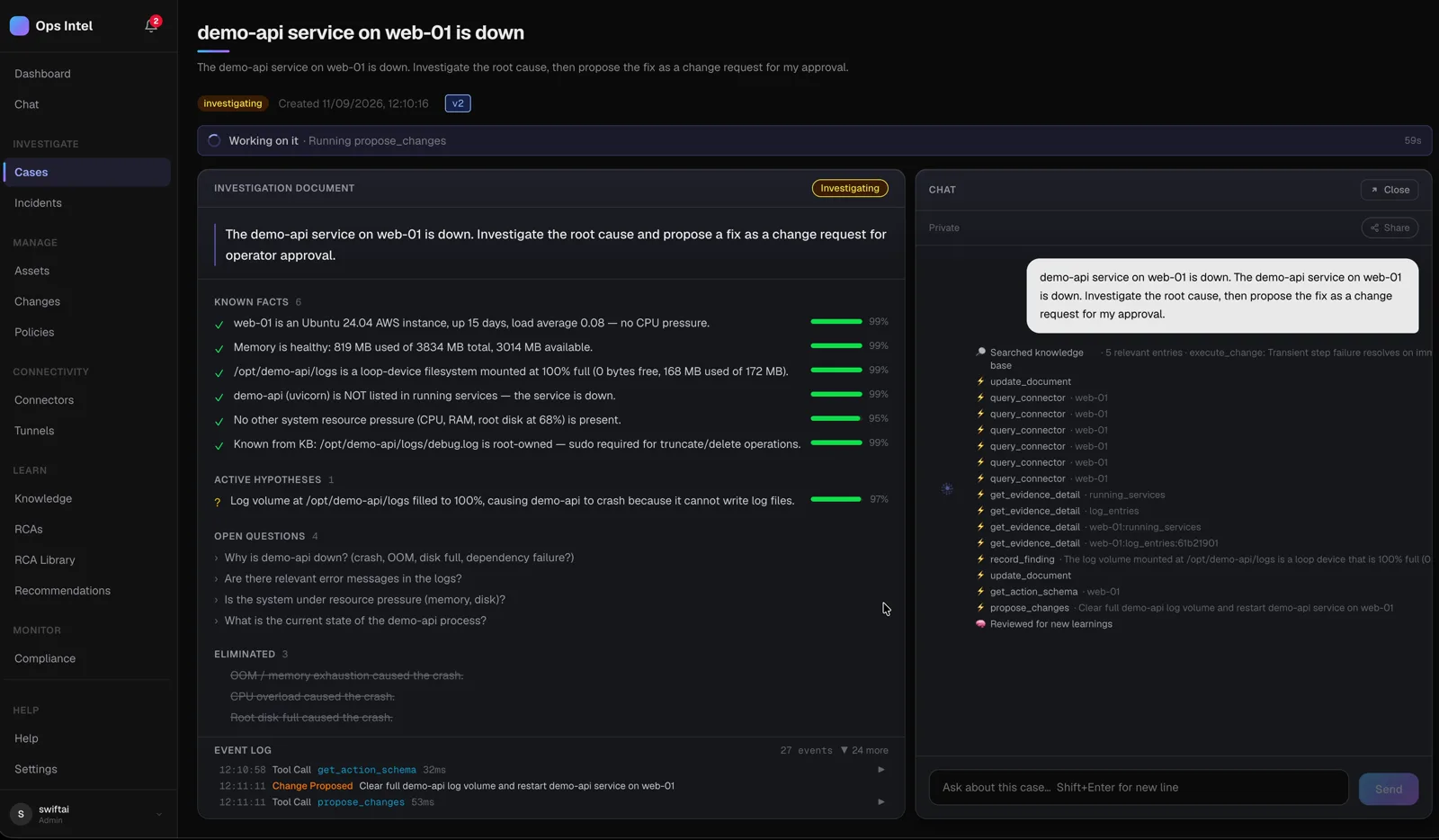
A real investigation on a real server — from “it's broken” to a fix you approved and an answer you keep.
Step 01
Start
In plain language. No runbook, no query syntax, nothing new to learn.
Step 02
Investigate
It logs into the box itself and checks the service, the logs, the disk — the same things you would.
Step 03
Work it out
Everything it finds is scored by confidence, so you can see the reasoning instead of taking its word for it.
Step 04
Propose
Every step, the exact command, which box it runs on, and how to undo it. Nothing happens on its own.
Step 05
Approve
It runs the steps in order and confirms the thing is actually back up before calling it done.
Step 06
Remember
It writes up what broke, why, and what fixed it. Searchable, so the answer is there in six months when it happens again.
Price
Prove it on one or two clients on the Personal plan, then move up when it earns its place. Starter is $149 for three users and five environments; Pro is $499 for ten users and fifteen.
Two environments and five connectors on Personal — enough to run it properly before you commit anything.
Starter, Pro and Max add users, connectors and environments. Upgrade in the app and the new limits apply immediately.
Card required, nothing charged until day 14, and cancelling before then costs you nothing.
The obvious questions
Yes — 14 days, on real client infrastructure. We ask for a card so it rolls straight into a subscription, but nothing is charged until day 14 and cancelling before then costs you nothing. The trial has a capped AI budget: enough for a few complete investigations, which is what it takes to know whether this is any use to you. Every investigation spends real money on AI tokens, so the cap is what makes a free trial possible at all.
No. A small agent runs on the client's network and dials out to us. Nothing listens on the internet, and there's no VPN or port forward to configure per site — which is usually the part that kills this kind of tool at the change-approval stage.
No. It proposes, a person approves. You see every command before it runs, on which host, with a rollback plan — and it's all logged, so you can show a client exactly what was done and who signed it off.
Today: UniFi Network, UniFi Protect, AWS, and anything you can reach over SSH — which covers most Linux boxes, including Proxmox and Docker hosts. A dedicated Proxmox connector is being built now. Ask for the one you want and it goes on the list.
Yes — that's what environments are for. Each client gets its own, with its own connectors, assets and knowledge, and an investigation runs inside a single environment. Two environments on the $29 plan, five on Starter, fifteen on Pro.
Not in the sense of giving each client their own login — environments separate your clients' systems and knowledge inside your account, for your team. Client-facing access isn't something we do today. Tell us if you need it.
Free for 14 days on real client infrastructure. Then $29 a month, cancel any time.
Start 14-day free trial